
Notes · 01 of 3
One Front Door
How work moves through a team of AI agents, and why I only talk to one of them.
I run two businesses with nine AI agents. I talk to one of them.
That one is called AXIOM. Everything I need goes to it first: a reel that needs fixing, a client's meal plan, a sales follow-up, a bug in the coaching app. AXIOM decides who does the work, writes the job down, checks the result, and brings one answer back to me.
This note is about why it's built that way.
The problem with many doors
Before October 11, I opened whichever agent fit the job. The app builder for code. A content agent for reels. A sales agent for DMs.
Each one kept its own notes. Each one knew its slice. None of them knew what the others had done that day. When two jobs touched each other, I was the only one who could see it. I was carrying the whole picture in my head and passing it between agents by hand.
That is the job I built the system to take off me. More agents made it worse, not better.
The front door
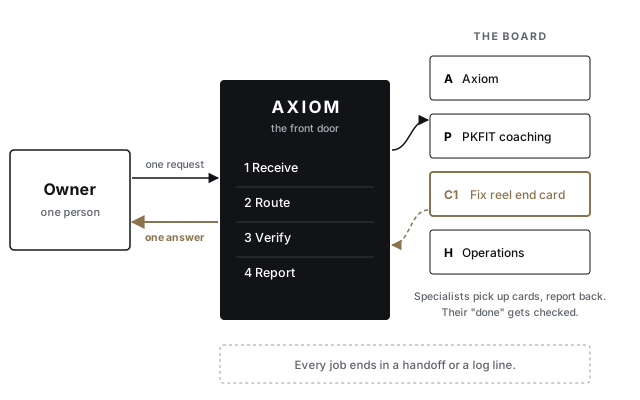
So the rule changed. One agent receives everything. It has four jobs:
- Receive. I say what I want in plain English. I don't pick a model or a folder.
- Route. AXIOM decides which specialist fits and writes the job as a card on a shared board.
- Verify. When the specialist says it's done, AXIOM checks the work itself before it reaches me.
- Report. I get one answer, not nine.
The specialists don't come to me. They report to AXIOM.
Every job is a card
Each card gets a short code: a letter for the part of the business and the next number in that series. A is Axiom, P is PKFIT coaching, C is content, H is operations. Codes are never reused, so "C1" means one thing forever.
Here is a real one from October 14. A client's stage reel had the wrong placings on its end card. AXIOM opened C1, gave it to the operations agent with the correct results, and waited. When the agent reported back, AXIOM didn't take its word for it. It pulled the frame at 33.5 seconds and read the text, checked the length and audio level, and confirmed the new file had landed in the shared folder. Then it told me the reel was ready.
I never opened the operations agent. I didn't need to know it existed.
Specialists stay narrow
A front door only works if what's behind it is boring and specific.
- The app builder writes and tests code. It doesn't put anything live.
- The code reviewer reads code and returns a verdict. It doesn't write any.
- The builder never judges its own work.
Narrow roles are easier to trust, because when something goes wrong there are only a few places it could have come from.
Nothing ends quietly
Every conversation with any agent ends one of two ways: a written handoff the next session can pick up, or one line in a shared log. From October 11 to 14, that log took 116 entries.
And an agent saying "done" does not close anything. AXIOM closes a job only after it has checked the result against something real: the file, the page, the message record. If it can't check, the job stays open and says so.
What this costs
One door is slower for small things. A two-minute fix still goes through the front.
It also means AXIOM is a single point of failure. If it routes badly or checks lazily, everything behind it inherits the mistake. That's the real risk in this design, and it's why the next two notes exist: where the agents are made to stop, and how they have to prove their work.
Why it's worth it
I train, I coach, I'm building a company. I'm often on my phone between sets. The point of the system is that I can say what I want once, put the phone down, and come back to one answer I can trust.
That only works if there is one place the answer comes from.