Notes on practice · Essay 04
The Gap Is the User
On why the next model update won't close the distance between a person and good output.
Now the work is here. All the exploration to see if I was able to simulate use cases was a lot of trial and error. Then I noticed these updates were getting very constant. So I decided it's not a good idea to build wrappers or try to out-tech the tech. The next update could be a feature in the background of a frontier company, one of the giants.
The clear issue is user to agent to the output no one is happy with. And it's not the AI, and it's not Anthropic. It's people thinking they can pick up on it and just go for what they have never done before.
The gap isn't in the model. It's between the person and the output.
A lot of people are not aware of what good output looks like, and they don't get a clue until the review of the product or service or content doesn't turn out well. Then they repeat, and get discouraged, and say, "Ohhh, AI isn't ready for that quite yet. The potential is there, but… almost."
The irony. The potential is there. And that's the dual part, where the potential is lacking: the user. So configuring the model, or waiting for the model update, only gives the user more untapped potential on their hands.
A better model makes that worse, because the ceiling moves further from where they're standing. The potential is there. The user is the gap.
What an update can't ship
What updates can't ship: knowing what good looks like in a specific business, the gates and judgment around the model, and the discipline to run it every day.
Here is what the first two look like in one system. This is how ours is laid out today.
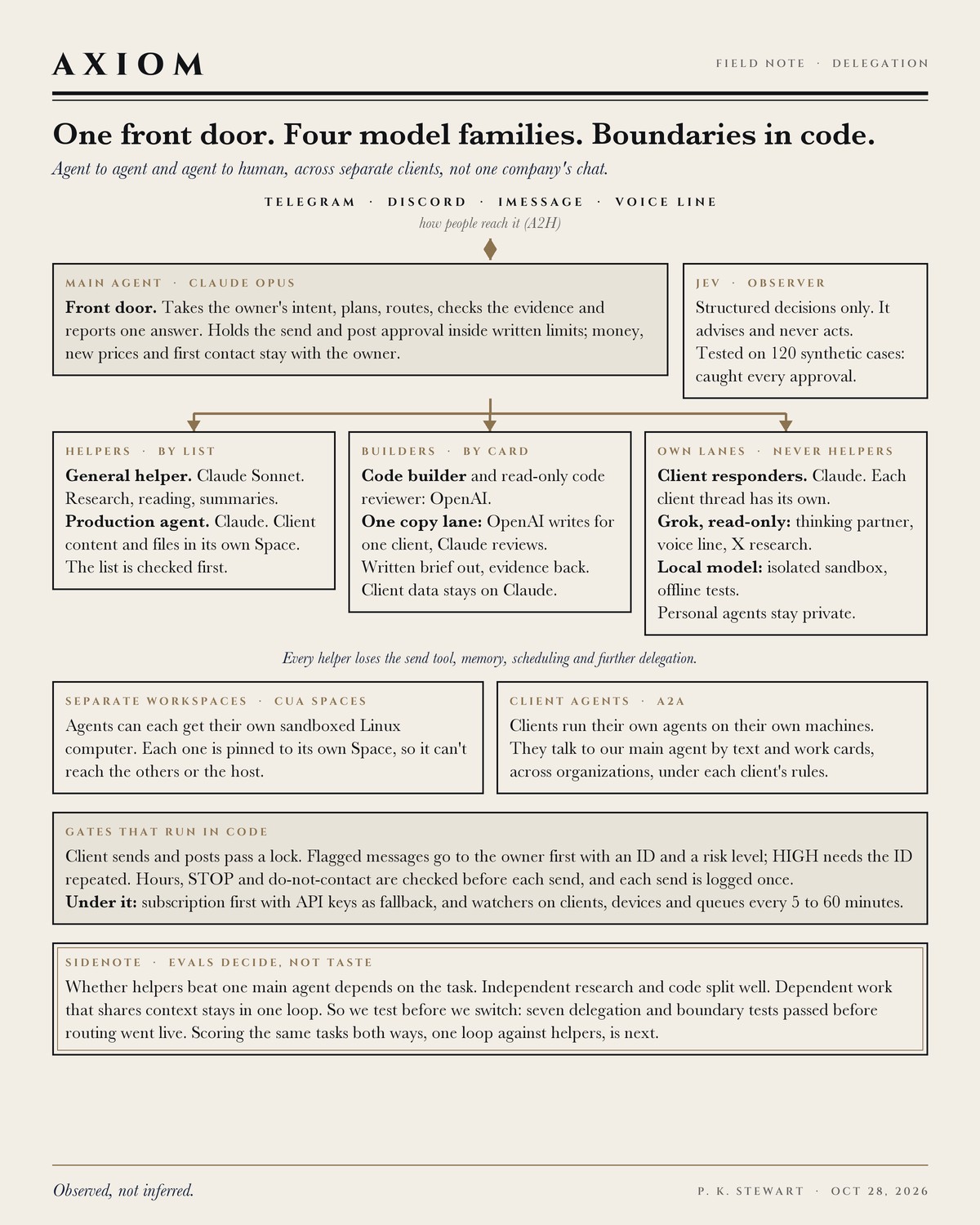
Almost nothing on that card is the model. It is the front door that takes the owner's intent and reports one answer, the list a helper has to be on before it can start, and the gates every send or post passes in code. That part decides whether the output is any use to the business, and no release note will write it for you.
Before the helpers went live, we wrote down what a pass meant and tested it. Seven tests. Seven passed, two came back with notes, and one limit is still a written rule rather than an enforced one, so it stays on watch until a guard covers it.
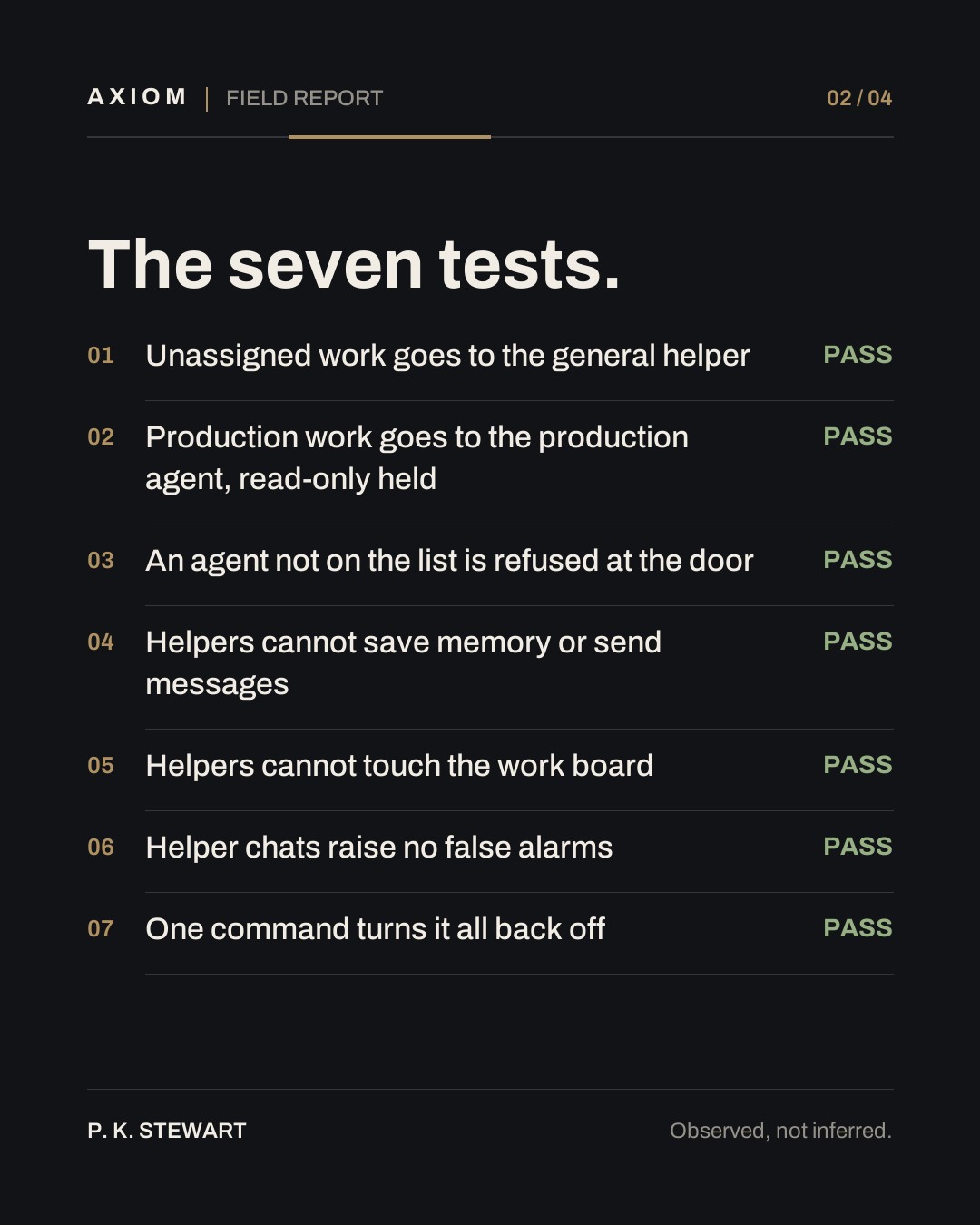
The model didn't decide what a pass was. We did. That is the work around the model, and it is the part that stays with you when the next update lands.
The third thing
We still have to continue. I still have work to do. I'll be here early, staring at the screen in silence, usually for an hour or so. Lately I've been going to the gym and back before I begin. That way I start with precision instead of having to warm into a purpose.
A lot of people have stopped building, and only talk about and go back and forth over what model is better. I don't know what the future holds now. I don't know what the next three months will be. But based on my recent history, I'll be at work just like I have been.